
giovedì 9 marzo 2023
Cosa vogliono le donne/Cosa ricevono

martedì 28 febbraio 2023
lunedì 27 febbraio 2023
Maria Tumarkin
Hello,
I’m a Ukrainian Jewish Australian, no hyphens or hyphens, I don’t care. My world (as I knew it) ended on 24 February 2022. I have no connection to any ‘interest groups’, ‘sponsorship money’, ‘Zionist lobby’, ‘pearl-clutching’ (snort!), ‘attempts to silence marginalised voices’, ‘propaganda’ propagation – what else have you got for me? I’d rather not be lectured on developing a higher tolerance for ‘confronting ideas’. All good on that front, thanks. I feel rage and no outrage. I don’t support calls for resignations, cancellations, or boycotts of Adelaide Writers’ Week.
I am not interested in being part of the discourse. Below is all I have to say. And then – mum’s the word. I won’t give interviews.
I’ve withdrawn from Adelaide Writers’ Week together with Ukrainian writers Olesya Khromeychuk and Kateryna Babkina. Both of them are astounding, by the way. So read them, will you?
In the last twelve months I’ve learned a lot and changed my mind a lot. Perhaps the most salient lesson is that anti-war can mean pro-genocide. It means pro-genocide right now in Ukraine. All the ‘peace now’ (Habermas et al) talk, all the ‘WWIII’ talk, all the ‘US proxy war’ and ‘Nato warmongering’ talk – all of it, all of them, especially when used as already-loaded-up projectiles – are forms of genocidal speech so long as Russian troops are killing, raping, torturing and kidnapping civilians across Ukraine, and so long as Russian missiles are destroying hospitals, schools and residential highrises with sleeping families inside them daily and nightly. Ukraine by now is the most mined country in the world. They mine dead mothers with still-alive babies tied to them. Oh, yes, the content note.
Statements in which Zelensky (who’s Jewish) is called a Nazi, fascist, someone responsible for Russia’s invasion of Ukraine and/or WWIII are not anti-Zelensky and/or pro-Putin. They are forms of genocide cheering (a step up from genocide apology). They do not exist in the space of discourse only and do not represent something that can be classified as merely a contentious political opinion. If only. I should mention Susan Abulhawa’s name of course but there are many people like her, maybe even very many and at least some are also accomplished writers. The respectability index doesn’t do much for me, personally. I don’t care if these people are published by Bloomsbury or by the Milkbars’ Association of Victoria. And while we’re on the subject, I see no difference between Twitter feeds and books if tweets are pro-genocidal and knowingly so. If they are about cats, I’m all for nuanced distinctions.
In her letter to Louise Adler, Olesya Khromeychuk wrote (I’m quoting her with permission):
In this war, Russia is targeting the Ukrainian people and their culture, a culture that has been ignored in the wider world for far too long, and has appeared on many cultural institutions’ radars only as it was being destroyed by the Russian bombs. Like my colleagues, I feel saddened that calls to be sensitive in relation to Ukrainians who have been attacked in this genocidal war and to not give a platform to voices that repeat Kremlin propaganda are not always heard.
In her letter to Louise Adler, Kateryna Babkina wrote (quoting with the author’s permission):
I’m afraid I can’t participate in any kind of event that gives voice to the person considering Ukrainians should give up their right to decide what to do with their destiny and their independent country and just become a ‘neutral nation’ pleasing Russian ambitions in order not to be killed.
Google Olesya and Kateryna, both, there’ll be plenty of their writing and thinking in English. There’ll be copies of Olesya’s book (I presume? I hope?) in the festival bookstore as well. Literary festivals are just, you know, festivals. They are not hallowed spaces, they are not public squares. The blood of the nation doesn’t travel through them to the nation’s brain all that often. I respect the fact that lots of people in Australia, writers and readers, get plenty out of them. Sometimes lifelong connections are formed. Also: solidarities, collaborations. I’ve seen people in tears, moved that much by a festival session. I like it that Adelaide Writers’ Week is free and outdoors. Free particularly is a big deal.
But. Literary festivals, as they operate in Australia, are not robust enough structures to hold space for writers with irreconcilable views and politics when these concern ongoing wars or genocidal violence. I.e. life and death. Irreconcilability. Tolerance, difference of opinion, dialogue, openness, civic discourse – even if we generously think of these as principles not self-serving slogans, they’re useless in the face of dehumanisation and violence which such irreconcilability creates overtly and covertly. Festivals haven’t yet developed their own version of the ‘ethics of incommensurability’ (Tuck and Yang, ‘Decolonization is not a Metaphor’, 2012), and because whatever they (festivals) have to offer on this front is sub-par but not recognised as such, they can be dangerous and harmful. This is my position on the anti-semitisms and anti-Palestinisms that certain kinds of Western arts programming throws fertiliser at in the name of what exactly? In my letter to Louise Adler I called this philosophy of programming ‘cruel, privileged innocence’ and I stand by these words. You cannot play compare-and-contrast with genocides but people do all the time (another thing I’ve learned, or re-learned) and festivals are not built to handle it.
Festivals’ insistence that it is possible and advisable to inhabit a realm of ideas when the living struggle to keep up with burying their dead make things worse. This insistence works to empty conversations (ostensibly about books) of actual politics and fills them instead with over-determined ideology. On all sides.
In my letter to Louise Adler (Louise published my first two books; we go back), I wrote:
I find the term ‘cancel culture’ meaningless. It’s caked in so much ideology and used so self-servingly by all sides that, to my mind, it is not remotely useful at all as a tool to think or make decisions with. It’s just a stick for hitting (in offence and self-defence) or for shooing away. I am not for it or against it or remotely interested in it.
I accepted Louise’s invitation to be part of Adelaide Writers’ Week because I was going to speak to Svetlana Alexievich, my hero, and because I could support Louise in bringing Ukrainian voices into the program. Olesya and Kateryna, I admire you. But, as I wrote to Louise, ‘Zelensky is my hero too’ (the last self-quote). I told Louise, I can’t do this.
I am thinking now about Iran, Turkey, Syria, Afghanistan. If you have a living connection to what’s happening in any of these places now, my heart is with you.
This writers’ week ‘story’ slash ‘controversy’ should be over by now. I’m not sure it’s doing anything at all but increasing pain and harm. No such thing as bad publicity? In any case, if you still feel agitated, please donate to Ukraine, Turkey, Syria or Iran. With Ukraine, please no humanitarian causes (if you can stomach it). Weapons only.
Thanks,
martedì 17 gennaio 2023
Mosca, gennaio 2023
In seguito all'attacco missilistico che ha provocato almeno 40 morti in un condominio di Dnipro, dei moscoviti hanno deposto fiori ai piedi del monumento dedicato alla poetessa Lesja Ukraïnka.
lunedì 26 settembre 2022
Saba
Berretto pipa bastone, gli spenti
oggetti di un ricordo.
oggetti di un ricordo.
Ma io li vidi animati indosso a uno
ramingo in un'Italia di macerie e di polvere.
Sempre di sé parlava ma come lui nessuno
ho conosciuto che di sé parlando
e ad altri vita chiedendo nel parlare
altrettanta e tanta più ne desse
a chi stava ad ascoltarlo.
E un giorno, un giorno o due dopo il 18 aprile,
lo vidi errare da una piazza all'altra
dall'uno all'altro caffè di Milano
inseguito dalla radio.
"Porca - vociferando - porca". Lo guardava
stupefatta la gente.
Lo diceva all'Italia. Di schianto, come a una donna
che ignara o no a morte ci ha ferito.
Vittorio Sereni
ramingo in un'Italia di macerie e di polvere.
Sempre di sé parlava ma come lui nessuno
ho conosciuto che di sé parlando
e ad altri vita chiedendo nel parlare
altrettanta e tanta più ne desse
a chi stava ad ascoltarlo.
E un giorno, un giorno o due dopo il 18 aprile,
lo vidi errare da una piazza all'altra
dall'uno all'altro caffè di Milano
inseguito dalla radio.
"Porca - vociferando - porca". Lo guardava
stupefatta la gente.
Lo diceva all'Italia. Di schianto, come a una donna
che ignara o no a morte ci ha ferito.
Vittorio Sereni
giovedì 23 giugno 2022
mercoledì 11 maggio 2022
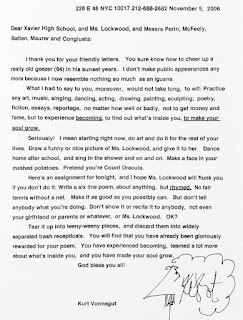
Dear Xavier High School
Dear Xavier High School, and Ms. Lockwood, and Messrs Perin, McFeely, Batten, Maurer and Congiusta:
What I had to say to you, moreover, would not take long, to wit: Practice any art, music, singing, dancing, acting, drawing, painting, sculpting, poetry, fiction, essays, reportage, no matter how well or badly, not to get money and fame, but to experience becoming, to find out what's inside you, to make your soul grow.
Seriously! I mean starting right now, do art and do it for the rest of your lives. Draw a funny or nice picture of Ms. Lockwood, and give it to her. Dance home after school, and sing in the shower and on and on. Make a face in your mashed potatoes. Pretend you're Count Dracula.
I thank you for your friendly letters. You sure know how to cheer up a really old geezer (84) in his sunset years. I don't make public appearances any more because I now resemble nothing so much as an iguana.
Seriously! I mean starting right now, do art and do it for the rest of your lives. Draw a funny or nice picture of Ms. Lockwood, and give it to her. Dance home after school, and sing in the shower and on and on. Make a face in your mashed potatoes. Pretend you're Count Dracula.
Here's an assignment for tonight, and I hope Ms. Lockwood will flunk you if you don't do it: Write a six line poem, about anything, but rhymed. No fair tennis without a net. Make it as good as you possibly can. But don't tell anybody what you're doing. Don't show it or recite it to anybody, not even your girlfriend or parents or whatever, or Ms. Lockwood. OK?
Tear it up into teeny-weeny pieces, and discard them into widely separated trash recepticals [sic]. You will find that you have already been gloriously rewarded for your poem. You have experienced becoming, learned a lot more about what's inside you, and you have made your soul grow.
God bless you all!
Kurt Vonnegut
Quello che dovevo dirvi, inoltre, non richiederebbe molto tempo, vale a dire: dedicatevi a qualsiasi tipo di arte, musica, canto, danza, recitazione, disegno, pittura, scultura, poesia, romanzo, saggio, reportage, non importa se bene o male, non per far soldi e diventare famosi, ma per provare a diventare, a trovare quello che avete dentro, a far crescere la vostra anima.
Non sto scherzando! Voglio dire, a cominciare da questo preciso istante, fate dell'arte e fatela per il resto della vostra vita. Tracciate un disegno carino della signora Lockwood e dateglielo. Andate a casa ballando dopo scuola e cantate nella doccia e avanti così. Ricavate una faccia dal puré di patate. Fate finta di essere il conte Dracula.
Tear it up into teeny-weeny pieces, and discard them into widely separated trash recepticals [sic]. You will find that you have already been gloriously rewarded for your poem. You have experienced becoming, learned a lot more about what's inside you, and you have made your soul grow.
God bless you all!
Kurt Vonnegut

Cari Scuola Superiore Xavier, signora Lockwood e signori Perin, McFeely, Batten, Maurer e Congiusta,
vi ringrazio per le vostre gentili lettere. Non c'è dubbio che sapete come rallegrare un rimbambito davvero vecchio nel tramonto dei suoi anni (84). Non compaio più in pubblico perché ora assomiglio più che mai ad un'iguana.
Quello che dovevo dirvi, inoltre, non richiederebbe molto tempo, vale a dire: dedicatevi a qualsiasi tipo di arte, musica, canto, danza, recitazione, disegno, pittura, scultura, poesia, romanzo, saggio, reportage, non importa se bene o male, non per far soldi e diventare famosi, ma per provare a diventare, a trovare quello che avete dentro, a far crescere la vostra anima.
Non sto scherzando! Voglio dire, a cominciare da questo preciso istante, fate dell'arte e fatela per il resto della vostra vita. Tracciate un disegno carino della signora Lockwood e dateglielo. Andate a casa ballando dopo scuola e cantate nella doccia e avanti così. Ricavate una faccia dal puré di patate. Fate finta di essere il conte Dracula.
Eccovi un compito per stasera, e spero che la signora Lockwood vi bocci se non lo fate: scrivete una poesia di 6 versi, su qualsiasi argomento, ma in rima. Giocare a tennis senza rete non è giusto. Fatelo bene per quanto è nelle vostre possibilità, ma non dite a nessuno cosa state facendo. Non mostratela o recitatela a nessuno, nemmeno alla vostra ragazza o ai vostri genitori o a chiunque altro, o alla signora Lockwood. OK?
Strappatela in pezzettini minuscoli e gettateli in diversi cestini molto distanti l'uno dall'altro. Scoprirete che siete stati già premiati con onore per la vostra poesia. Avrete sperimentato cosa vuol dire diventare, imparato molto di più quello che avete dentro, e fatto crescere la vostra anima.
Dio vi benedica tutti!
Kurt Vonnegut
Strappatela in pezzettini minuscoli e gettateli in diversi cestini molto distanti l'uno dall'altro. Scoprirete che siete stati già premiati con onore per la vostra poesia. Avrete sperimentato cosa vuol dire diventare, imparato molto di più quello che avete dentro, e fatto crescere la vostra anima.
Dio vi benedica tutti!
Kurt Vonnegut
mercoledì 9 marzo 2022
A letter to Ukraine from Sarajevo / Una lettera all'Ucraina da Sarajevo
Link.
La pagina dovrebbe durare per più di un anno, dice la BBC. Speriamo anche noi.
***
Cari amici,
le organizzazioni umanitarie qui a Sarajevo stanno raccogliendo aiuti per voi e io sono seduta di fronte all'armadio del mio appartamento cercando di ricordarmi di cosa potete avere più bisogno. Non sono le mie calze calde o la mia giacca o i miei stivali caldi di cui avete più bisogno ora: è la mia maglietta vecchia di trent'anni, stampata con lo slogan che mi ha fatto resistere durante i 1425 giorni durante cui i serbi di Bosnia hanno sparato a volontà e tenuto la mia città sotto assedio, senz'acqua, senza cibo, senza elettricità, senza riscaldamento e senza comunicazioni con il mondo esterno. Ho portato quella maglietta e letto il suo messaggio mentre più di 2 milioni di granate cadevano sulle nostre teste e schivavo innumerevoli proiettili. Quella maglietta dice: "Sarajevo sarà, tutto il resto passerà".
Vi aspettano tempi brutti, amici miei, ma vi sono state spedite armi, per cui vi potete difendere. Noi, bosniaci, contrattaccammo, ma il mondo ci impose un embargo sulle armi. Non capì di che lotta si trattava a Sarajevo. Grazie a Dio, lo capisce adesso a Kyïv.
Avrete fame, sete, freddo, sarete sporchi, perderete le vostre case, i vostri amici e parenti, ma quello che vi farà più male saranno le bugie. Le bugie secondo cui voi siete in qualche modo colpevoli per quello che vi sta succedendo. Le bugie secondo cui voi in realtà state facendo quello che è stato fatto a voi. Queste bugie pianteranno migliaia di buchi nei vostri cuori, ma senza fermare il loro battito e senza ghiacciarli.
Vedo che hanno distrutto la vostra torre della televisione: vogliono tenervi al buio, proprio come tennero al buio noi. Vogliono spegnere le luci, in modo che non possiamo vedere quello che vi stanno facendo.
Scrivete tut-to. Registratelo. Un giorno definirà la vostra storia. Spiegherà agli ucraini che non sono ancora nati che cosa è successo e, molto probabilmente, finirà per essere usato come prova in tribunale contro quelli che stanno cercando di uccidervi.
Nei tempi bui che sono davanti a voi, perderete la fiducia, qualche volta, e sarete stremati, ma vi sto scrivendo dal futuro e vi sto dicendo: vincerete, proprio come facemmo noi. Io dovevo essere morta, ma sono sopravvissuta. Porterò i miei nipoti a fare una camminata, domani. Anche voi lo farete, un giorno, perché vedo in voi la stessa resilienza che vidi qui, vi sento cantare il vostro inno mentre respingete i carri armati a mani nude. Col tempo, canterete, come facemmo noi, canzoni nuove sul vostro coraggio durante questo dramma. E troverete i vostri slogan che vi terranno in vita.
Per ora, tuttavia, vi mando la cosa più preziosa che io abbia: è il mio slogan, un po' modificato per voi: "L'Ucraina sarà, tutto il resto passerà".
Slava Ukraïni.
Sarajevo,
Aida Čerkez

mercoledì 2 marzo 2022
Invasione/Вторжение
No, non è un conflitto Ucraina-Russia o Russia-Ucraina, non è una guerra Ucraina-Russia o viceversa, non è una crisi ucraina, non è assolutamente una questione ucraina. L'ultima espressione è particolarmente velenosa perché avvalora e integra nel linguaggio corrente la prospettiva putiniana, esattamente come la "questione ebraica" avvalorava quella hitleriana. Tanto meno è una "operazione militare speciale" ("специальная военная операция"), come detta Putin ai suoi organi di propaganda o a quelli di informazione sottoposti al suo controllo e alla sua censura.
Quella in corso è un'invasione russa dell'Ucraina o un'invasione dell'Ucraina da parte della Russia. Non abbiamo saputo o voluto vederla venire a dispetto delle aggressioni militari precedenti, non sappiamo o vogliamo riconoscerla ora che si mostra in tutta la sua violenza e la sua estensione, non sappiamo o vogliamo neanche nominarla per quel che è. Porta alla guerra, in Ucraina e forse altrove, ma stiamo assistendo ad un'invasione.
martedì 1 marzo 2022
« La guerre en Ukraine, non, ce n’est pas la Russie qui la fait mais les chars de Poutine »
Je ne suis retourné en Tchécoslovaquie qu’une seule fois de ma vie, en 1977. Cette année-là, mes parents avaient décidé d’y passer un mois entier, à Prague, puis à la campagne, chez des amis russo-tchèques, Frantichek et Natacha, en Moravie. Et je me souviens de la façon dont les gens se retournaient sur nous, avec froideur, avec colère, quand ils nous entendaient parler russe. Je parlais français avec mon père – tout était sourire, gentillesse. J’avais le malheur de dire un mot en russe à ma mère et plus rien n’existait, qu’une haine froide, résignée. Et je me sentais coupable sans l’être, coupable de partager la langue de ces gens qui avaient délibérément tué l’espoir. Je n’ai jamais voulu retourner à Prague, à cause de ça, et c’est le même sentiment qui me revient aujourd’hui, de honte et d’amertume impuissantes.
André Markowicz, Le Monde, 1 mars 2022
La guerra in Ucraina, no, non è la Russia che la fa, ma i carri di Putin
Sono ritornato in Cecoslovacchia una sola volta in vita mia, nel 1977. Quell'anno, i miei genitori avevano deciso di passarvi un mese intero, prima a Praga, poi in campagna, da degli amici russo-cechi, František et Nataša, in Moravia. E mi ricordo del modo in cui la gente si voltava verso di noi, con freddezza, con rabbia, quando ci sentiva parlare russo. Quando parlavo francese con mio padre, era tutto un sorriso e una gentilezza. Se per caso mi scappava una parola in russo con mia madre, non c'era altro che odio freddo, rassegnato. E mi sentivo colpevole senza esserlo, colpevole di condividere la lingua delle persone che avevano deliberatamente ucciso la speranza. Non ho mai voluto ritornare a Praga per questo motivo, ed è lo stesso sentimento che riaffiora oggi, di vergogna e di amarezza impotenti.
André Markowicz, nato a Praga da madre russa, ha tradotto in francese l'opera omnia narrativa di Dostoevskij e, con Françoise Morvan, "Il maestro e Margherita" di Michail Bulgakov.
mercoledì 5 gennaio 2022
È andata così
Nato nel 1937, a Sondrio, due passi dalla Svizzera. – Sei mesi di vita a Sondrio. – Padre usciere di banca, litiga col proprio direttore. – Padre condannato per punizione a trasferimenti da un capo all’altro della penisola a proprie spese. – Famiglia viaggiante. – Tre anni a Trapani. – Sette anni a Belluno. – Tre anni a Ferrara. – Liceo a Bologna. – Fine della vita in famiglia. – Viaggio in Germania e quasi matrimonio. – Ritorno a Bologna, studi di linguistica. – Passa il tempo. – Servizio militare. – Grazie a un amico psichiatra si concentra a studiare le scritture dei matti. – Nevrosi da naja, ospedale militare. – Tesi di laurea su Joyce. – Epatite virale, isolamento. – Raptus di scrivere come un certo matto che lo appassiona. – Italo Calvino legge il testo su una rivista, propone di farne un libro. – Passa il tempo. – Vita in Tunisia. – Matrimonio. – Prime traduzioni. – Bologna, impiegato in una ditta di dischi. – Studia logica con Enzo Melandri ma risulta incapace. – Borsa di studio a Londra 1968-70. – Pubblica libro. – Parte per gli u.s.a. – Due anni alla Cornell University. – Vita nel falso, tutto per darla da bere agli altri. – Passa il tempo. – Insegna all’università di Bologna. – Conosce un certo Alberto Sironi che lo mette a scrivere film falliti in partenza. – Altro libro. – Traduzioni. – Passa il tempo. – Quattro mesi tra California, Kansas e Queens. – Senso di non aver più la terra sotto i piedi, come uno partito in orbita. – Passa il tempo. – Parigi, rue Simon-le-Franc, un anno di convalescenza. – Torna a Bologna, di nuovo all’università. – Conosce Luigi Ghirri, fotografo. – Lavoro rasserenante con i fotografi. – Esplorazioni della Valle Padana. – Periodi a scrivere in giro. – Si trasferisce in Normandia. – Traduzioni. – Altro libro. – Con Daniele Benati, Ermanno Cavazzoni, Ugo Cornia, Marianne Schneider, Jean Talon fonda “Il semplice, Almanacco delle prose”. – Stati Uniti, Rhode Island, insegna sei mesi. – Passa il tempo. – Trasferimento in Inghilterra. – Comincia a fare documentari. – Viaggio in Africa occidentale con J. Talon. – Passa il tempo. – Altri documentari. – Tutto a monte, nessuna speranza, nessun timore. – Borsa Fulbright a Chicago. – In Africa, Senegal, a curarsi la testa. – Un anno a Berlino, borsa daad. – Film in Senegal, incapace di finirlo. – L’Italia invivibile. – Campa facendo conferenze. – È andata così. – Dal 1990 a Brighton, Inghilterra, con la moglie Gillian Haley. –
Testo tratto da Riga 40. Gianni Celati, a cura di Marco Belpoliti, Marco Sironi e Anna Stefi, Quodlibet, 2019

Testo tratto da Riga 40. Gianni Celati, a cura di Marco Belpoliti, Marco Sironi e Anna Stefi, Quodlibet, 2019
lunedì 25 ottobre 2021
I was sitting on my patio this guy appeared I thought I was hallucinating
PROLOGUE The stage is set but dark except for a spotlighted telephone on a small aluminum table downstage left. The telephone begins ringing continuously 10 minutes before the curtain. After 10 minutes, as the houselights dim in a count of ten seconds, the light on the phone grows brighter. Blackout. The lights come up in one second to reveal a room as the phone stops ringing. The backdrop is a black wall with 3 open arches. Behind the arches very bright lighting suggests an open space. Against the black wall there is an illuminated glass shelf, on which is a spotlighted wine glass. Upstage right a man wearing a white silk shirt, a black silk robe, black silk hose and black slippers is lying on a brushed aluminum chaise longue.He ignores his surroundings and moves in a totally self absorbed manner following his own thoughts in silence for 4 minutes. Blackout. When the lights come up the arches have been blocked in from top to bottom with gray filing books, and a small movie screen hangs just under the proscenium arch downstage right. The man leans forward and speaks his words punctuated by music played on an offstage piano. ACT I I was sitting on my patio this guy appeared I thought I was hallucinating I was walking in an alley you are beginning to look a little strange to me I'm going to meet them outside have you been living here long NO just a few days would you like to come in sure would you like something to drink nice place you've got don't shoot don't shoot and now will you tell me how we're going to find our agents might as well turn off the motor and save gas don't just stand there go and get help I've never seen anything like it what are you running away from [you] you has he gotten here yet has who gotten here yet NO what would you say that was [what would you say that was] 125 [1 2 5] very well [very well] play opposum [play opposum] open the doors [open the doors] one you all set [one you all set] go behind the door [go behind the door] now is the time to get away [now is the time to get away] 1 and 2 [1 and 2] I'll be with you in just a minute [I'll be with you in just a minute] I'll be with you in just a minute [I'll be with you in just a minute] oh hello that's just the call I was waiting for [oh hello that's just the call I was waiting for] ready aim fire [ready aim fire] aim fire [aim fire] where [where] you're here for ulterior motives I graduate with honors you're O.K. watch out father [father] NO NO NO 15 years ago I remember the address it was 7 Pearl Street I must keep that in my mind or was it 7 years ago the reindeer are getting restless there's a mechanical drummer...


Robert Wilson
Christopher Nell
Julie Shanahan
Me ne stavo seduto in terrazza quando questo tizio è sbucato ho pensato di aver avuto un'allucinazione
PROLOGO Il palcoscenico è pronto ma buio, a parte un telefono sotto un riflettore su un tavolino di alluminio sul proscenio a sinistra. Il telefono comincia a squillare di continuo, 10 minuti prima del sipario. Dopo 10 minuti, all'affievolirsi delle luci nel corso di dieci secondi, la luce puntata sul telefono diventa più luminosa. Oscuramento. Le luci ritornano in un secondo a rivelare una stanza nel momento in cui il telefono smette di squillare. Lo sfondo è una parete nera con 3 arcate aperte. Dietro le arcate, un'illuminazione molto luminosa suggerisce uno spazio aperto. Contro la parete nera c'è uno scaffale di vetro illuminato su cui è posato un bicchiere di vino, sotto un riflettore. Sul palcoscenico a destra un uomo con una camicia di seta bianca, una vestaglia di seta nera, pantaloni di seta nera e pantofole nere giace su una chaise longue di alluminio spazzolato. Ignora lo spazio circostante e si muove in modo completamente avulso dalla realtà, ripiegato su se stesso, seguendo i propri pensieri in silenzio per 4 minuti. Oscuramento. Quando le luci ritornano, le arcate risultano bloccate in tutta la loro altezza da raccoglitori grigi, ed un piccolo schermo è appeso sotto l'arco di proscenio a destra. L'uomo si china in avanti e pronuncia le proprie parole punteggiate da musica riprodotta da un piano dietro le quinte. ATTO I Me ne stavo seduto in terrazza quando questo tizio è sbucato ho pensato di aver avuto un'allucinazione stavo camminando in una strada stai cominciando a sembrarmi un po' strano li incontrerò fuori è da molto che vivi qui NO solo da pochi giorni vorresti entrare certo gradiresti qualcosa da bere che posto carino non sparare non sparare ed ora mi vuoi dire come troveremo i nostri agenti potresti anche spegnere il motore e risparmiare carburante non stare lì impalato vai a chiedere aiuto non ho mai visto niente di simile da cosa stai scappando [tu] tu è riuscito a venire è chi è riuscito a venire NO cosa diresti che è stato [cosa diresti che è stato] 125 [1 2 5] molto bene [molto bene] gioca all'oppossum (sic) [giocare all'oppossum] apri le porte [apri le porte ] una che siete sistemati (sic) [una che siete sistemati] vai dietro la porta [vai dietro la porta] ora è il momento di andare via [ora è il momento di andare via] 1 e 2 [1 e 2] sarò da te in un minuto [sarò da te in un minuto] sarò da te in un minuto [sarò da te in un minuto] oh ciao è solo la telefonata stavo aspettando un [oh ciao è solo la telefonata stavo aspettando un] pronti mirare fuoco [pronti mirare fuoco] mirare fuoco [mirare fuoco] dove [dove] sei qui per ulteriori motivi mi laureo con lode stai bene bada a tuo padre [padre] NO NO NO 15 anni fa mi ricordo che l'indirizzo era 7 Pearl Street devo ricordarmelo oppure era 7 anni fa le renne si stanno inquietando c'è un tamburo meccanico...
Versione originale presentata il 5 aprile del 1977 alla Eastern Michigan University, Ypsilanti, Michigan, con Alan Lloyd (musica), Robert Wilson e Lucinda Childs (attori).
Rirappresentata il 20 settembre del 2021 all'Espace Cardin (Théâtre de la Ville), Parigi, Francia, in occasione degli 80 anni di Wilson, con Carlos Soto (costumi), Nick Sagar (suono), Christopher Nell e Julie Shanahan (attori).
sabato 18 settembre 2021
Yo fui educado a la antigua
Yo fui educado a la antigua, y nunca creí que me fueran a ordenar un día que matara a una mujer. A las mujeres no se las toca, no se les pega, no se les hace daño físico y el verbal se les evita al máximo, a esto último ellas no corresponden. Es más, se las protege y respeta y se les cede el paso, se las escuda y ayuda si llevan un niño en su vientre o en brazos o en un cochecito, les ofrece uno su asiento en el autobús y en el metro, incluso se las resguarda al andar por la calle alejándolas del tráfico o de lo que se arrojaba desde los balcones en otros tiempos, y si un barco zozobra y amenaza con irse a pique, los botes son para ellas y para sus vástagos pequeños (que les pertenecen más que a los hombres), al menos las primeras plazas. Cuando se va a fusilar en masa, a veces se les perdona la vida y se las aparta; se las deja sin maridos, sin padres, sin hermanos y aun sin hijos adolescentes ni por supuesto adultos, pero a ellas se les permite seguir viviendo enloquecidas de dolor como a espectros sufrientes, que sin embargo cumplen años y envejecen, encadenados al recuerdo de la pérdida de su mundo. Se convierten en depositarias de la memoria por fuerza, son las únicas que quedan cuando parece que no queda nadie, y las únicas que cuentan lo habido.
Bueno, todo esto me enseñaron de niño y todo esto era antes, y no siempre ni a rajatabla. Era antes y en la teoría, no en la práctica. Al fin y al cabo, en 1793 se guillotinó a una Reina de Francia, y con anterioridad se quemó a incontables acusadas de brujería y a la soldado Juana de Arco, por no poner más que un par de ejemplos que todos conocen.
Sí, claro que siempre se ha matado a mujeres, pero era algo a contracorriente y que en muchas ocasiones daba reparo, no es seguro si a Ana Bolena se le concedió el privilegio de sucumbir a una espada y no a una tosca y chapucera hacha, ni tampoco en la hoguera, por ser mujer o por ser Reina, por ser joven o por ser hermosa, hermosa para la época y según los relatos, y los relatos jamás son fiables, ni siquiera los de testigos directos, que ven u oyen turbiamente y se equivocan o mienten. En los grabados de su ejecución aparece de rodillas como si estuviera rezando, con el tronco erguido y la cabeza alta; de habérsele aplicado el hacha tendría que haber apoyado el mentón o la mejilla en el tajo y haber adoptado una postura más vejatoria y más incómoda, haberse tirado por los suelos, como quien dice, y haber ofrecido una visión más prominente de sus posaderas a quienes desde su ángulo se las encontraran de frente. Curioso que se tuviera en cuenta la comodidad o compostura de su último instante en el mundo, y aun el garbo y el decoro, qué más daría todo eso para quien ya era inminente cadáver y estaba a punto de desaparecer de la tierra bajo la tierra, en dos pedazos. También se ve, en esas representaciones, al ‘espada’ de Calais, así llamado en los textos para diferenciarlo de un vulgar verdugo —traído ex profeso por su gran destreza y quizá a petición de la propia Reina—, siempre a su espalda y oculto a su vista, nunca delante, como si se hubiese acordado o decidido que la mujer se ahorrara ver venir el golpe, la trayectoria del arma pesada que sin embargo avanza veloz e imparable, como un silbido una vez que se emite o como una ráfaga de viento fuerte (en un par de imágenes ella lleva los ojos vendados, pero no en la mayoría); que ignorara el momento preciso en que su cabeza quedaría cortada de un solo mandoble limpio, y caída en la tarima boca arriba o boca abajo o de lado, de pie o de coronilla, quién sabía, desde luego ella no lo sabría jamás; que el movimiento la pillara por sorpresa, si es que puede haber sorpresa cuando uno sabe a lo que ha venido y por qué está de rodillas y sin manto a las ocho de la mañana de un día inglés de aún frío mayo. Está de rodillas, justamente, para facilitarle la tarea al verdugo y no poner su habilidad en entredicho: había hecho el favor de cruzar el Canal y de prestarse, y a lo mejor no era muy alto. Al parecer, Ana Bolena había insistido en que con una espada bastaba, ya que su cuello era fino. Debió de rodeárselo con las manos más de una vez, a modo de prueba.
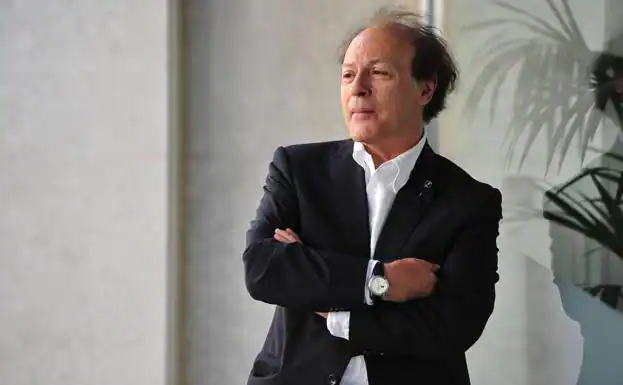
Incipit di Tomás Nevinson di Javier Marías
mercoledì 15 settembre 2021
Bibliothek
die vielen buchstaben
die nicht aus ihren wörtern können
die vielen wörter
die nicht aus ihren sätzen können
die vielen sätze
die nicht aus ihren texten können
die vielen texte
die nicht aus ihren büchern können
die vielen bücher
mit dem vielen staub darauf
die gute putzfrau
mit dem staubwedel
Ernst Jandl

Biblioteca
le numerose lettere
che non riescono ad uscire dalle loro parole
le numerose parole
che non riescono ad uscire dalle loro frasi
le numerose frasi
che non riescono ad uscire dai loro testi
i numerosi testi
che non riescono ad uscire dai loro libri
i numerosi libri
con tanta polvere sopra
la buona signora delle pulizie
col piumino
venerdì 3 settembre 2021
Il test
Signora triestina sessantenne seduta ad un tavolo di un ristorante, rivolta ai suoi commensali, con tono grave:
"Questo no xe un vaccino, no, no xe un vaccino, xe un test mondiale".
giovedì 13 maggio 2021


venerdì 16 aprile 2021
Fateci tornare a casa
"Basta, non ne possiamo più. Mi rivolgo ai governanti: per favore fateci ritornare a casa, fateci ritornare nei nostri teatri, fateci ritornare nei nostri spazi di cultura. Per una crescita personale, ma soprattutto per la crescita di uno stato che vuole essere adulto e responsabile".
Gianni Forte, 14 aprile 2021
Per il teatro, per la cultura, per nutrire il cervello, per la vita.
lunedì 1 marzo 2021
12
A Lisa S.
- Personnellement, j'ai jamais vraiment arrêté
de donner de dictées. C'est un moment
vraiment sympa. Les mômes sont extrêmement
de donner de dictées. C'est un moment
vraiment sympa. Les mômes sont extrêmement
concentrés, à faire une seule chose à la fois
impossible de lever le nez sinon tu rates
un mot, tout le monde est bien aligné
dans la même position, on entend les mouches.
Bref, c'est très reposant. Et puis
ils sentent qu'ils font quelque chose d'important.
En tout cas, ils font comme s'ils le sentaient. La
tentation, ce serait de tout dicter histoire d'avoir la paix.
Mais ça marche pas. Si tu dictes
autre chose qu'une dictée, t'as le bordel. Le bordel
le brouhaha, ou un peu de bruit, c'est ce que tu as
quand tu ne dictes pas une dictée, et ça, faut bien
se le mettre dans la tête et le plus vite possible,
si on veut pas être déçu. Après, il y a des moments de
concentration très aigus, seuls ou à plusieurs
mais la qualité de silence que t'as
avec la dictée, y a rien de comparable. Seuls les profs
qui font régner la terreur l'obtiennent. Je suppose qu'on
pense que ces profs-là n'existent plus, mais y en a
encore, par petites unités, un par bahut. Y a un
deuxième avantage que t'as avec la dictée
c'est la correction. Rien de plus cool à corriger
qu'une dictée : ça demande zéro concentration.
Tu peux très bien écouter la radio ou
regarder la télé en même temps ; c'est de la
mécanique. Toujours les mêmes fautes sur les mêmes
mots, du coup tu finis par passer à vitesse grand V
sur toutes les copies et t'abats
un paquet de trente en une demi-heure max.
Y a rien de plus rapide à corriger qu'un paquet de
dictées. T'as des notes, tu les rends, les parents
comprennent et tout le monde est content.
On a pu faire chier des profs pour une phrase
dans Artaud ou dans Zola, un geste ou de
l'humour mal compris, mais on a jamais emmerdé
personne parce qu'il donnait trop de dictées - en
tout cas, j'en ai jamais entendu parler. La dictée notée
sur 20, c'est le seul exercice où tu peux te récolter
- 40, et à ce que je sache, ça n'a jamais étonné
personne. - 40, c'est probablement un dyslexique.
En 2010, ils se tapaient encore la dictée en entier
et la descente en enfer. La plupart
on croyait qu'ils étaient bêtes.
C'est là que d'un coup, à un moment, j'ai réalisé
que mes meilleurs amis étaient nuls en orthographe
et que je vivais avec un dyslexique qu'on avait pris
pour un abruti pendant toute sa scolarité et qui
finalement avait fait des études supérieures -
tout comme mes amis nuls en orthographe. Mais alors
s'il y avait des gens nuls en orthographe et capables
de développer une pensée et une appréhension
sensible du monde, ça impliquait a contrario
qu'il y avait des gens à l'orthographe impeccable
qui pensaient comme des pommes ou qui étaient
vraiment cons.
On connaît tous des cons qui font pas de fautes, non ?
Il paraît que sur les applis de rencontres, ça trie
par l'orthographe
ceux qui écrivent sans fautes branchent
ceux qui écrivent sans fautes
et s'auto-sélectionnent comme ça socialement
sous-entendu que les pauvres sont incapables
d'aligner deux lignes et en général de s'exprimer?
C'est pour ainsi dire l'aboutissement d'une manière
de voir les choses, la société telle qu'elle fonctionne
et telle qu'on croit qu'elle est ; pour ainsi dire le
couronnement d'une centaine d'années d'école
publique et privée, confessionnelle ou laïque et
obligatoire, parce qu'un niveau de l'orthographe et de
son respect c'est pareil des deux côtés. On peut
s'écharper sur le genre de rapport au zizi
mais certainement pas sur l'accord du
participe passé avec avoir quand le complément d'
objet direct est placé avant le verbe, là, tout le monde
est d'accord pour dire que le savoir c'est une preuve d'
intelligence puisque c'est pas facile à comprendre
(et en effet, c'est incompréhensible). Récemment
j'étais surprise de ce que de plus en plus de mes
collègues laissaient des fautes
dans leurs communications (depuis l'arrivé de
l'informatique, on n'arrête pas de s'écrire). Les mômes
aussi le remarquent :
- Vous avez vu, monsieur Truc il fait plein de fautes !
Je tempère :
- Lamartine aussi il en faisait plein, et il est devenu
député. Malgré tout, j'avais dans la tête que les
fonctionnaires font pas de fautes, pas parce que
le concours agirait magiquement et que dès lors
que vous l'avez passé vous n'en faites plus, bien sûr
mais parce que l'orthographe, c'est quelque chose
d'extrêmement surveillé dans la fonction publique
tout comme les fonctionnaires sont extrêmement
surveillés (c'est ce qu'on appelle le devoir de réserve).
Eh bien, ni l'un ni l'autre.
Il n'y a aucun texte de loi qui dise que le fonctionnaire
doit avoir une bonne orthographe. Y a bien une
légende, celle du décret 1832. Mais ce fameux
décret, il a jamais existé que dans les têtes. Pareil
pour le devoir de réserve dans l'armée, mais pas
dans l'éducation publique ; c'est d'ailleurs la raison
pour laquelle un ministre a dernièrement inclus
un entrefilet de loi dans lequel il précise que désormais
il y a un devoir d'exemplarité pour les profs
(c'est parce que des profs avaient un peu rechigné à sa
réforme ; il aime pas que ses profs rechignent). Du coup
le devoir de réserve dans l'éducation nationale
il a jamais existé que dans les têtes aussi.
C'est assez troublant quand même, cette manie
de s'inventer des lois qui existent pas dans le droit et
qui vont toutes dans le même sens de plus de
contraintes. Par exemple
(en tout cas dans l'éducation nationale)
on se met jamais à fantasmer des lois qui iraient vers
plus de liberté ou plus d'égalité. On se fabrique
son petit droit en interne
qui fait jouer le martinet. Plus royaliste que le roi.
Plus dirigeant que l'Etat. Plus
administrant que l'institution.
Plus répressif que la
police.
Nathalie Quintane, Un hamster à l'école, La fabrique éditions, 2021

- Personalmente, non ho mai davvero smesso
di assegnare dei dettati. È un momento
veramente bello. I ragazzi sono estremamente
di assegnare dei dettati. È un momento
veramente bello. I ragazzi sono estremamente
concentrati, a fare una cosa sola alla volta,
impossibile alzare il naso, altrimenti perdi
una parola, tutti sono ben allineati
nella stessa posizione, si sentono volare le mosche.
Insomma, è molto riposante. E poi
sentono di fare qualcosa d'importante.
Ad ogni modo, fanno finta di sentirlo. La
tentazione sarebbe di dettare tutto, tanto per avere pace.
Ma non funziona. Se detti
una cosa diversa da un dettato, il casino è garantito. Il casino,
il baccano o un po' di rumore è quello che hai
quando non detti un dettato, e questo bisogna ben
metterselo in testa e il più rapidamente possibile,
se non si vuole restare delusi. Dopo, ci sono dei momenti di
concentrazione molto intensa, da soli o in gruppo,
ma la qualità di silenzio che hai
col dettato, non c'è niente di comparabile. Solo i prof
che fanno regnare il terrore lo ottengono. Suppongo che si
pensi che questi prof non esistano più, ma ce ne sono
ancora, in piccole unità, uno per scuola. C'è un
secondo vantaggio che hai col dettato:
è la correzione. Niente di più tranquillo che correggere
un dettato: richiede concentrazione zero.
Puoi benissimo ascoltare la radio o
guardare la tivù allo stesso tempo; è questione di
meccanica. Sempre gli stessi sbagli con le stesse
parole, per cui finisci per passare alla velocità con la V maiuscola
su tutte le copie e fai fuori
una pila di trenta compiti in massimo mezz'ora.
Non c'è niente di più rapido da correggere di un pacco di
dettati. Hai dei voti, li dai, i genitori
capiscono e tutti sono contenti.
Si son potute rompere le palle a dei prof per una frase
di Artaud o di Zola, un gesto o del-
l'umorismo frainteso, ma non si è mai rotto
a nessuno perché dava troppi dettati - in
ogni caso, non ne ho mai sentito parlare. Il dettato con un voto da 1
a 10 è il solo esercizio in cui puoi prenderti un
- 40 e, che io sappia, un voto così non ha mai stupito
nessuno. - 40, si tratta probabilmente di un dislessico.
Nel 2010, si beccavano ancora tutto il dettato
e la discesa agli inferi. La maggior parte di
noi credeva che fossero stupidi.
È a quel punto che, a un dato momento, ho capito
che i miei migliori amici erano nulli in ortografia
e che vivevo con un dislessico, scambiato
per un imbecille durante tutta la sua carriera scolastica, che
alla fine aveva fatto degli studi superiori -
esattamente come tutti i miei amici nulli in ortografia. Ma allora
se c'era gente nulla in ortografia e capace
di sviluppare un pensiero e un apprendimento
sensibile del mondo, questo implicava a contrario
che c'era gente dall'ortografia perfetta
che pensava come una patata o che era
davvero mona.
Conosciamo tutti dei mona che non fanno sbagli, no?
Sembra che sulle app di incontri si selezioni
in base all'ortografia
quelli che scrivono senza errori cuccano
quelli che scrivono senza errori
e si autoselezionano così socialmente,
sottinteso che i poveri sono incapaci
di allineare due righe e in generale di esprimersi?
È, per così dire, l'esito di un modo
di vedere le cose, la società come funziona
e come crediamo che sia; per così dire, il
coronamento di un centinaio di anni di scuola
pubblica e privata, cattolica o laica e
dell'obbligo, perché un certo livello in ortografia e il
suo rispetto è uguale in entrambe. Ci si può
massacrare sul tipo di rapporto con il pisello,
ma certamente non sull'accordo del
participio passato con il verbo avere quando il complemento
oggetto diretto si trova davanti al verbo, in quel caso, tutti
sono d'accordo nel dire che saperlo è una prova di
intelligenza, dato che non è facile da capire
(e, in effetti, è incomprensibile). Di recente
sono rimasta sorpresa dal fatto che sempre più numerosi sono i
colleghi che lasciano degli errori
nelle loro comunicazioni (dall'arrivo del-
l'informatica è tutto uno scriversi). Anche
i ragazzi lo notano :
- Ha visto, il signor XY fa un sacco di errori!
Io modero:
- Anche Lamartine ne faceva un sacco, ed è diventato
deputato. Nonostante tutto, avevo in testa che i
funzionari non commettono errori, non perché
il concorso agirebbe magicamente e perché quando
l'avete passato non ne fate più, chiaro,
ma perché l'ortografia è qualcosa
di estremamente controllato nella funzione pubblica
proprio come sono controllati
i funzionari (è il cosidetto dovere di riservatezza).
Ebbene, non esiste né l'uno né l'altro.
Non esiste nessun testo di legge che dica che il funzionario
debba avere una buona ortografia. È una pura
leggenda, quella del decreto del 1832. Ma questo famoso
decreto è esistito solo nelle teste. Idem
per il dovere di riservatezza nell'esercito, ma non
nella pubblica istruzione; è del resto la ragione
per cui un ministro ha recentemente incluso
un trafiletto di legge in cui precisa che ormai
esiste un dovere di esemplarità per i prof
(è perché i prof erano un po' recalcitranti alla sua
riforma; non gli piace che i prof siano recalcitranti). Allora
il dovere di riservatezza nella pubblica istruzione
è anch'esso esistito solo nelle teste.
È abbastanza inquietante, però, questa mania
di inventarsi delle leggi che non esistono nel diritto e
che vanno tutte nella stessa direzione di più
obblighi. Per esempio
(in ogni caso nella pubblica istruzione)
non ci si mette mai a fantasticare di leggi che vadano verso
più libertà o più uguaglianza. Ci si costruisce
il proprio piccolo diritto interno
che fa muovere la frusta. Più realista del re.
Più dirigente dello Stato. Più
amministratore dell'istituzione.
Più repressivo della
polizia.
martedì 9 febbraio 2021
A volte ritornano: il fine orecchio di Giove
Dopo anni di inani tentativi e molte insistenze, non appena riavutasi dall'ultimo, clamoroso insuccesso, la dea della democrazia, Sola, è riuscita di nuovo, appena qualche giorno fa, ad arrivare al cospetto di Giove e si è rivolta a lui ancora più accorata perché ascolti davvero, infine, le preci del popolo di Roma.
- Gioove! Gioove! Gioove!
- ...
- Gioove!
- ...
- AGGIOVE!
- Anvedi, ancora la pischella. Che d'è?
- Giove, sono 27 anni che non muovi neanche un dito mignolo, per il popolo di Roma.
- E daje co' 'sta storia. Nun me va de faticà, gnaafò. So' stanco, c'ho da fà, che, no 'o sai? C'ho 'na fila de ggente che me chiede de interrompe l'ultima epidemia.
- Fallo almeno per Europa: non provi più un briciolo d'amore per Europa?
- Eh, certo che lo provo. Tutti i ggiorni che mando sulla tera, lo provo.
- Allora rispondi al popolo di Roma. Dice che se gli dai quello che chiede, Europa ritorna da te, in tutto il suo splendore.
- Eh, ma l'altra vorta mica è tornata da me, Europa.
- Ma scusa, che ti aspettavi? T'avevano chiesto mari e monti, Giove, e tu Mario Monti gli avevi dato.
- Gioove! Gioove! Gioove!
- ...
- Gioove!
- ...
- AGGIOVE!
- Anvedi, ancora la pischella. Che d'è?
- Giove, sono 27 anni che non muovi neanche un dito mignolo, per il popolo di Roma.
- E daje co' 'sta storia. Nun me va de faticà, gnaafò. So' stanco, c'ho da fà, che, no 'o sai? C'ho 'na fila de ggente che me chiede de interrompe l'ultima epidemia.
- Fallo almeno per Europa: non provi più un briciolo d'amore per Europa?
- Eh, certo che lo provo. Tutti i ggiorni che mando sulla tera, lo provo.
- Allora rispondi al popolo di Roma. Dice che se gli dai quello che chiede, Europa ritorna da te, in tutto il suo splendore.
- Eh, ma l'altra vorta mica è tornata da me, Europa.
- Ma scusa, che ti aspettavi? T'avevano chiesto mari e monti, Giove, e tu Mario Monti gli avevi dato.
- Ma davero? Nun me ricordo bbene. E comunque che vvo', er popolo de Roma, adesso?
- Sai, la situazione è così complicata, che ora vorrebbe che gli mandassi dei maghi, a sbrogliare i casini di varia natura in cui si trovano.
- E che cce vo'. Eccheteli tiè.
- E che cce vo'. Eccheteli tiè.
martedì 2 febbraio 2021
The Hill We Climb
When day comes we ask ourselves
Where can we find light in this never-ending shade?
The loss we carry,
A sea we must wade.
We braved the belly of the beast;
We’ve learned that quiet isn’t always peace.
And the norms and notions of what just is
Isn’t always justice.
And yet the dawn is ours before we knew it.
Somehow we do it;
Somehow we’ve weathered and witnessed
A nation that isn’t broken but simply unfinished.
We, the successors of a country and a time
Where a skinny black girl descended from slaves
And raised by a single mother can dream of becoming president,
Only to find herself reciting for one.
And yes we are far from polished, far from pristine,
But that doesn’t mean we aren’t striving to form a union that is perfect.
We are striving to forge a union with purpose,
To compose a country committed to all cultures, colors, characters and conditions of man.
And so we lift our gaze not to what stands between us,
But what stands before us.
We close the divide, because we know to put our future first,
We must first put our differences aside.
We lay down our arms
So we can reach out our arms to one another.
We seek harm to none and harmony for all.
Let the globe, if nothing else, say this is true:
That even as we grieved, we grew,
That even as we hurt, we hoped,
That even as we tired, we tried,
That we’ll forever be tied together, victorious—
Not because we will never again know defeat
But because we will never again sow division.
Scripture tells us to envision
That everyone shall sit under their own vine and fig tree,
And no one shall make them afraid.
If we’re to live up to our own time,
then victory won’t lie in the blade but in all the bridges we’ve made.
That is the promised glade,
The hill we climb if only we dare it.
Because being American is more than a pride we inherit,
It’s the past we step into and how we repair it.
We’ve seen a force that would shatter our nation rather than share it,
Would destroy our country if it meant delaying democracy.
And this effort very nearly succeeded,
But while democracy can be periodically delayed
It can never be permanently defeated.
In this truth, in this faith we trust,
For while we have our eyes on the future, history has its eyes on us.
This is the era of just redemption.
We feared at its inception.
We did not feel prepared to be the heirs of such a terrifying hour,
But within it we found the power
To author a new chapter,
To offer hope and laughter,
To ourselves sow. While once we asked:
How could we possibly prevail over catastrophe?
Now we assert: How could catastrophe possibly prevail over us?
We will not march back to what was,
But move to what shall be,
A country that is bruised but whole,
Benevolent but bold,
Fierce and free.
We will not be turned around or interrupted by intimidation
Because we know our inaction and inertia will be the inheritance of the next generation.
Our blunders become their burdens
But one thing is certain:
If we merge mercy with might and might with right,
Then love becomes our legacy
And change our children’s birthright.
So let us leave behind a country better than the one we were left.
With every breath of my bronze pounded chest,
We will raise this wounded world into a wondrous one.
We will rise from the golden hills of the West.
We will rise from the windswept Northeast where our forefathers first realized revolution.
We will rise from the lakeland cities of the Midwestern states.
We will rise from the sunbaked South.
We will rebuild, reconcile and recover
In every known nook of our nation,
In every corner called our country,
Our people, diverse and beautiful,
Will emerge battered and beautiful.
When day comes we step out of the shade,
Aflame and unafraid.
The new dawn blooms as we free it.
For there is always light if only we’re brave enough to see it,
If only we’re brave enough to be it.

La collina che scaliamo
Where can we find light in this never-ending shade?
The loss we carry,
A sea we must wade.
We braved the belly of the beast;
We’ve learned that quiet isn’t always peace.
And the norms and notions of what just is
Isn’t always justice.
And yet the dawn is ours before we knew it.
Somehow we do it;
Somehow we’ve weathered and witnessed
A nation that isn’t broken but simply unfinished.
We, the successors of a country and a time
Where a skinny black girl descended from slaves
And raised by a single mother can dream of becoming president,
Only to find herself reciting for one.
And yes we are far from polished, far from pristine,
But that doesn’t mean we aren’t striving to form a union that is perfect.
We are striving to forge a union with purpose,
To compose a country committed to all cultures, colors, characters and conditions of man.
And so we lift our gaze not to what stands between us,
But what stands before us.
We close the divide, because we know to put our future first,
We must first put our differences aside.
We lay down our arms
So we can reach out our arms to one another.
We seek harm to none and harmony for all.
Let the globe, if nothing else, say this is true:
That even as we grieved, we grew,
That even as we hurt, we hoped,
That even as we tired, we tried,
That we’ll forever be tied together, victorious—
Not because we will never again know defeat
But because we will never again sow division.
Scripture tells us to envision
That everyone shall sit under their own vine and fig tree,
And no one shall make them afraid.
If we’re to live up to our own time,
then victory won’t lie in the blade but in all the bridges we’ve made.
That is the promised glade,
The hill we climb if only we dare it.
Because being American is more than a pride we inherit,
It’s the past we step into and how we repair it.
We’ve seen a force that would shatter our nation rather than share it,
Would destroy our country if it meant delaying democracy.
And this effort very nearly succeeded,
But while democracy can be periodically delayed
It can never be permanently defeated.
In this truth, in this faith we trust,
For while we have our eyes on the future, history has its eyes on us.
This is the era of just redemption.
We feared at its inception.
We did not feel prepared to be the heirs of such a terrifying hour,
But within it we found the power
To author a new chapter,
To offer hope and laughter,
To ourselves sow. While once we asked:
How could we possibly prevail over catastrophe?
Now we assert: How could catastrophe possibly prevail over us?
We will not march back to what was,
But move to what shall be,
A country that is bruised but whole,
Benevolent but bold,
Fierce and free.
We will not be turned around or interrupted by intimidation
Because we know our inaction and inertia will be the inheritance of the next generation.
Our blunders become their burdens
But one thing is certain:
If we merge mercy with might and might with right,
Then love becomes our legacy
And change our children’s birthright.
So let us leave behind a country better than the one we were left.
With every breath of my bronze pounded chest,
We will raise this wounded world into a wondrous one.
We will rise from the golden hills of the West.
We will rise from the windswept Northeast where our forefathers first realized revolution.
We will rise from the lakeland cities of the Midwestern states.
We will rise from the sunbaked South.
We will rebuild, reconcile and recover
In every known nook of our nation,
In every corner called our country,
Our people, diverse and beautiful,
Will emerge battered and beautiful.
When day comes we step out of the shade,
Aflame and unafraid.
The new dawn blooms as we free it.
For there is always light if only we’re brave enough to see it,
If only we’re brave enough to be it.
Amanda Gorman
Quando arriva il giorno ci chiediamo
Dove possiamo trovare la luce in quest'ombra senza fine?
Con la perdita che ci portiamo dietro,
È un mare che dobbiamo attraversare.
Abbiamo affrontato la tana del lupo;
Abbiamo imparato che il silenzio non vuol sempre dire pace.
Dove possiamo trovare la luce in quest'ombra senza fine?
Con la perdita che ci portiamo dietro,
È un mare che dobbiamo attraversare.
Abbiamo affrontato la tana del lupo;
Abbiamo imparato che il silenzio non vuol sempre dire pace.
E le norme e le idee di quel che è giusto
Non sono sempre giustizia.
E tuttavia l'alba è nostra prima che lo sapessimo.
In qualche modo la creiamo;
In qualche modo abbiamo resistito e siamo stati testimoni
Di una nazione che non è spezzata, ma solo incompiuta.
Noi, gli eredi di un paese e di un tempo
In cui una magra ragazza nera con schiavi, tra i suoi antenati,
Non sono sempre giustizia.
E tuttavia l'alba è nostra prima che lo sapessimo.
In qualche modo la creiamo;
In qualche modo abbiamo resistito e siamo stati testimoni
Di una nazione che non è spezzata, ma solo incompiuta.
Noi, gli eredi di un paese e di un tempo
In cui una magra ragazza nera con schiavi, tra i suoi antenati,
Ed allevata da una madre sola, può sognare di diventare presidente,
Solo per trovarsi a declamare per uno.
E sì, siamo tutto fuorché raffinati e puri,
Ma questo non vuol dire che non ci stiamo battendo per creare un'unione che sia perfetta.
Ci stiamo battendo per forgiare un'unione con uno scopo,
Per comporre un paese votato a tutte le culture, a tutti i colori, a tutti i caratteri e a tutte le condizioni dell'uomo.
E allora mettiamoci a guardare non quello che si erge tra di noi,
Ma quello che si erge dinanzi a noi.
Colmiamo lo spazio che ci divide, perché sappiamo anteporre il futuro,
Dobbiamo innanzi tutto mettere da parte le nostre differenze.
Stendiamo le braccia
Per potercele toccare l'un l'altro.
Non cerchiamo di danneggiare nessuno, cerchiamo armonia per tutti.
Possa se non altro il mondo dire che questo è vero:
Che persino con le lacrime, siamo cresciuti,
Che persino facendo male agli altri, abbiamo sperato,
Che persino stancandoci, ci abbiamo provato,
Che saremo legati per sempre assieme, vittoriosi—
Non perché non conosceremo mai più la sconfitta
Ma perché non semineremo mai più la divisione.
Le scritture ci dicono di immaginare
Che ognuno siederà sotto la propria vite e il proprio fico,
E nessuno gli farà paura.
Se dobbiamo essere all'altezza del nostro tempo,
allora la vittoria non sarà nella lama, ma in tutti i ponti che avremo costruito.
Quella è la radura promessa,
La collina che scaliamo se solo osiamo farlo.
Perché essere americano è più di un orgoglio che ereditiamo,
È il passato in cui entriamo e il modo in cui lo ripariamo.
Abbiamo visto una forza che manderebbe in frantumi la nostra nazione piuttosto di condividerla,
Distruggerebbe il nostro paese se intendesse ritardare la democrazia.
E questo sforzo per pochissimo non ha avuto successo,
Ma mentre la democrazia può essere periodicamente sospesa
Non può essere mai definitivamente sconfitta.
In questa verità, in questa fede confidiamo,
Perché mentre rivolgiamo gli occhi al futuro, la storia rivolge i suoi su di noi.
Questa è l'era del riscatto e basta.
Abbiamo avuto paura, quando è iniziato.
Non ci siamo sentiti preparati a diventare gli eredi di un'ora così terribile,
Ma in questo lasso di tempo abbiamo trovato la forza
Di scrivere un nuovo capitolo,
Solo per trovarsi a declamare per uno.
E sì, siamo tutto fuorché raffinati e puri,
Ma questo non vuol dire che non ci stiamo battendo per creare un'unione che sia perfetta.
Ci stiamo battendo per forgiare un'unione con uno scopo,
Per comporre un paese votato a tutte le culture, a tutti i colori, a tutti i caratteri e a tutte le condizioni dell'uomo.
E allora mettiamoci a guardare non quello che si erge tra di noi,
Ma quello che si erge dinanzi a noi.
Colmiamo lo spazio che ci divide, perché sappiamo anteporre il futuro,
Dobbiamo innanzi tutto mettere da parte le nostre differenze.
Stendiamo le braccia
Per potercele toccare l'un l'altro.
Non cerchiamo di danneggiare nessuno, cerchiamo armonia per tutti.
Possa se non altro il mondo dire che questo è vero:
Che persino con le lacrime, siamo cresciuti,
Che persino facendo male agli altri, abbiamo sperato,
Che persino stancandoci, ci abbiamo provato,
Che saremo legati per sempre assieme, vittoriosi—
Non perché non conosceremo mai più la sconfitta
Ma perché non semineremo mai più la divisione.
Le scritture ci dicono di immaginare
Che ognuno siederà sotto la propria vite e il proprio fico,
E nessuno gli farà paura.
Se dobbiamo essere all'altezza del nostro tempo,
allora la vittoria non sarà nella lama, ma in tutti i ponti che avremo costruito.
Quella è la radura promessa,
La collina che scaliamo se solo osiamo farlo.
Perché essere americano è più di un orgoglio che ereditiamo,
È il passato in cui entriamo e il modo in cui lo ripariamo.
Abbiamo visto una forza che manderebbe in frantumi la nostra nazione piuttosto di condividerla,
Distruggerebbe il nostro paese se intendesse ritardare la democrazia.
E questo sforzo per pochissimo non ha avuto successo,
Ma mentre la democrazia può essere periodicamente sospesa
Non può essere mai definitivamente sconfitta.
In questa verità, in questa fede confidiamo,
Perché mentre rivolgiamo gli occhi al futuro, la storia rivolge i suoi su di noi.
Questa è l'era del riscatto e basta.
Abbiamo avuto paura, quando è iniziato.
Non ci siamo sentiti preparati a diventare gli eredi di un'ora così terribile,
Ma in questo lasso di tempo abbiamo trovato la forza
Di scrivere un nuovo capitolo,
Di cominciare a regalarci
Speranza e riso. Mentre una volta chiedevamo:
Speranza e riso. Mentre una volta chiedevamo:
Come potremmo mai avere la meglio sulla catastrofe?
Ora affermiamo: Come potrebbe mai la catastrofe avere la meglio su di noi?
Non marceremo indietro su ciò che è stato,
Ma ci muoveremo verso quello che sarà,
Ora affermiamo: Come potrebbe mai la catastrofe avere la meglio su di noi?
Non marceremo indietro su ciò che è stato,
Ma ci muoveremo verso quello che sarà,
Un paese ferito, ma integro,
Gentile, ma coraggioso,
Fiero e libero.
Non ci gireremo o ci fermeremo per un'intimidazione
Perché sappiamo che la mancanza di azione e l'inerzia saranno l'eredità della prossima generazione.
Fiero e libero.
Non ci gireremo o ci fermeremo per un'intimidazione
Perché sappiamo che la mancanza di azione e l'inerzia saranno l'eredità della prossima generazione.
I nostri errori diventano i loro oneri
Ma una cosa è sicura:
Se coniughiamo la compassione con il potere e il potere con il diritto,
Allora l'amore diventerà il nostro lascito
E cambierà il diritto di nascita dei nostri figli.
Lasciamoci allora alle spalle un paese migliore di quello che ci è stato dato.
Con ogni respiro del mio petto di bronzo,
Ma una cosa è sicura:
Se coniughiamo la compassione con il potere e il potere con il diritto,
Allora l'amore diventerà il nostro lascito
E cambierà il diritto di nascita dei nostri figli.
Lasciamoci allora alle spalle un paese migliore di quello che ci è stato dato.
Con ogni respiro del mio petto di bronzo,
Trasformeremo questo mondo ferito in uno splendido.
Ci alzeremo dalle colline dorate dell'Ovest.
Ci alzeremo dal Nord-est spazzato dal vento dove i nostri antenati per primi hanno compiuto la rivoluzione.
Ci alzeremo dalle città sui laghi degli stati del Midwest.
Ci alzeremo dal Sud indurito dal sole.
Ricostruiremo, riconcilieremo e guariremo
In ogni nicchia nota della nostra nazione,
In ogni angolo che si chiama il nostro paese,
Ci alzeremo dalle colline dorate dell'Ovest.
Ci alzeremo dal Nord-est spazzato dal vento dove i nostri antenati per primi hanno compiuto la rivoluzione.
Ci alzeremo dalle città sui laghi degli stati del Midwest.
Ci alzeremo dal Sud indurito dal sole.
Ricostruiremo, riconcilieremo e guariremo
In ogni nicchia nota della nostra nazione,
In ogni angolo che si chiama il nostro paese,
Il nostro popolo, variegato e bellissimo,
Emergerà malmenato e bellissimo.
Quando si fa giorno, usciamo dall'ombra,
In fiamme e senza paura.
La nuova alba fiorisce a mano a mano che la liberiamo.
Perché c'è sempre luce, se solo siamo abbastanza coraggiosi da vederela,
Se solo siamo abbastanza coraggiosi da esserla.
Quando si fa giorno, usciamo dall'ombra,
In fiamme e senza paura.
La nuova alba fiorisce a mano a mano che la liberiamo.
Perché c'è sempre luce, se solo siamo abbastanza coraggiosi da vederela,
Se solo siamo abbastanza coraggiosi da esserla.